The Charleston County Probate Court handles estates, wills, trusts, and guardianships in Charleston County, SC. It oversees the distribution of property and ensures legal compliance when someone passes away. The court appoints personal representatives, validates wills, and resolves disputes between heirs. Residents and legal professionals rely on it for fair and organized estate management. This court also issues marriage licenses and supervises certain trust matters.
The probate court in Charleston County, SC, provides a clear legal process for managing assets and protecting the rights of beneficiaries. As part of the Charleston County Court system, it handles families through estate administration, trust oversight, and guardianship appointments in accordance with state requirements. By supervising estate settlements, the court helps prevent conflicts and ensures South Carolina law is followed. Lawyers, executors, and heirs frequently interact with the Charleston County Court to handle property distribution efficiently. Serving both residents and legal representatives, the court remains central to civil and probate matters in Charleston County.
What Is the Charleston County Probate Court?
The Charleston County Probate Court handles legal matters related to estates, wills, guardianships, and other personal legal affairs. It ensures proper administration of property, family matters, and official records within Charleston County, South Carolina.
The Charleston County Probate Court has jurisdiction over a variety of cases, including estate settlements, validating wills, appointing guardians for minors or incapacitated adults, and overseeing trusts. It also issues marriage licenses and certain other official documents. Residents, family members, and legal representatives turn to the probate court when managing estates, planning for guardianship, or handling legal family matters.
Who the Court Serves
The court primarily serves residents of Charleston County, including family members, legal representatives, and individuals needing official documentation.
Common situations for visiting the probate court include:
- Settling a deceased person’s estate
- Filing or validating a will
- Requesting guardianship for a minor or incapacitated adult
- Establishing or managing a trust
- Obtaining a marriage license
The court operates as a local point of contact for these legal matters, providing guidance and official approvals. It ensures that all filings meet South Carolina legal requirements and that family and personal property matters are handled appropriately.
Search Charleston County Probate Records
Finding Charleston County probate records involves either online or in-person methods. Users can quickly locate wills, estate filings, and guardianship cases by following clear procedures, using official portals, or visiting the probate office directly.
How to Search Court Records Online
The official Charleston County Probate Court website is the primary source for online searches. Approved third-party tools may also provide access, but verifying information through the court portal ensures accuracy.
Steps for online record searches:
- Visit the official probate website: https://www.charlestoncounty.org/departments/probate/index.php
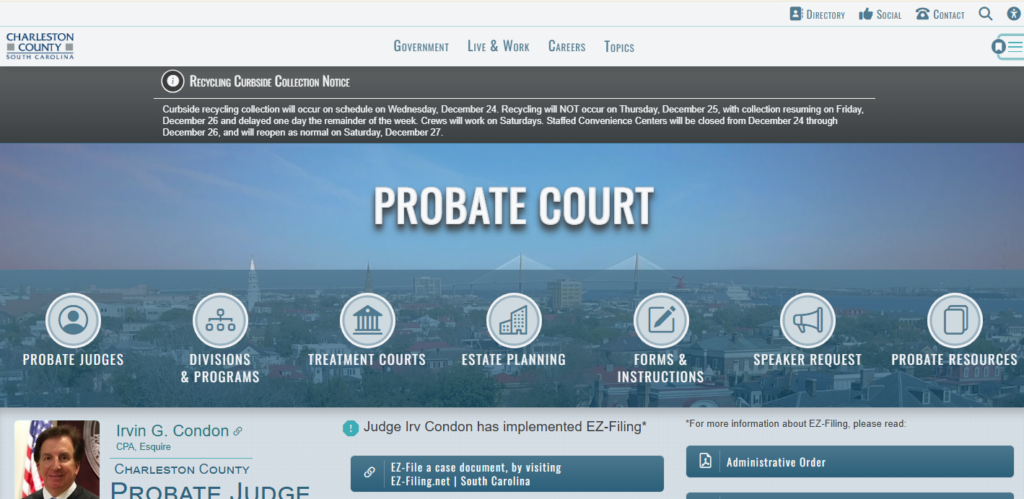
- Click on Estate / Guardianship / Probate Records.
- Enter the full legal name, estate name, or case number.
- Apply filters by case type, status, or filing date.
- Access downloadable PDFs if available.
Costs: Most online searches are free, but downloading certified copies or official PDFs may incur a small fee (usually $0.25–$1.00 per page).
Searching Probate Records In-Person
Visiting the Charleston County Probate Court office allows users to access physical records, request certified copies, or get staff assistance.
Court Office Details:
- Location: 100 Broad Street, Charleston, SC 29401
- Hours: Monday–Friday, 8:30 AM–5:00 PM
- Phone: (843) 958-5000
Steps for in-person searches:
- Bring a valid government-issued ID.
- Request the specific probate or estate filings needed.
- Pay applicable photocopy or document fees.
- Staff can assist with locating guardianship filings and older case records.
Costs:
- Photocopies: ~$0.25 per page
- Certified copies: ~$1.00 per page
- Special requests may vary
Jurisdiction & Functions of the Probate Court
The Charleston County Probate Court handles matters involving estates, wills, guardianships, and certain personal legal filings. It provides a formal legal process to manage and protect property, personal affairs, and family responsibilities.
Estates and Wills
The court oversees the administration of deceased persons’ estates. This includes validating wills, appointing executors, and ensuring that assets are distributed according to legal instructions.
Probate filings related to estates often involve:
- Opening an estate and filing the necessary documentation
- Inventorying and appraising assets
- Handling claims from creditors
- Distributing property to heirs
When a person passes away without a will, the court follows South Carolina intestacy laws to determine how assets are distributed.
Guardianship Cases & Conservatorships
Charleston County Probate Court handles guardianship cases for minors or incapacitated adults. Guardians are appointed to manage the personal, financial, or medical affairs of those unable to make decisions independently. Similarly, conservatorships may be established for individuals with limited financial or legal capacity.
Typical court responsibilities include:
- Reviewing petitions for guardianship or conservatorship
- Monitoring guardians’ actions through periodic reports
- Approving or adjusting guardianship arrangements
These cases ensure protection and legal oversight for vulnerable individuals in the county.
Probate Filings & Case Types
The court accepts a variety of probate filings beyond estates and guardianships, such as:
- Administration of small estates – simplified process for modest assets
- Trust approvals and modifications – when trust funds need court authorization
- Affidavits of heirship – establishing legal heirs without a full probate process
- Estate accountings – tracking financial transactions of the estate
Each filing requires careful documentation and adherence to South Carolina probate procedures.
Marriage Licenses
The Probate Court also issues marriage licenses for residents of Charleston County. Applicants must provide identification, pay a fee, and meet the state’s age and consent requirements. The court provides official certification, allowing couples to marry legally within South Carolina.
Commitment Proceedings
The court reviews petitions for involuntary commitment, ensuring legal standards protect individuals with mental health challenges. Judges evaluate medical evidence, consider family input, and authorize treatment when necessary.
Distinction from Other South Carolina Courts
Charleston County Probate Court differs from other courts:
- Circuit Courts handle criminal cases, large civil disputes, and appeals from lower courts.
- Family Courts address divorce, child custody, and domestic matters.
- Probate Court focuses on estate management, guardianships, trusts, marriage licenses, and certain mental health proceedings.
By concentrating on these specific functions, the Probate Court provides specialized oversight and legal authority for personal, family, and estate matters.
Probate Court Divisions Explained
The Charleston County Probate Court handles matters related to estates, guardianships, and certain personal legal affairs. Its divisions focus on estate administration, guardianship, conservatorship, commitments, and marriage licensing, ensuring proper legal oversight for residents. While Family Court proceedings are managed by a separate judicial system, the Probate Court often addresses related issues such as guardianships and conservatorships that may arise from family-related circumstances, supporting lawful decision-making and protection of vulnerable individuals.
Estate Division
The Estate Division manages the administration of a deceased person’s assets, including handling wills and estates, paying debts, and distributing property to heirs. It ensures all probate filings comply with South Carolina law and protects both creditors and beneficiaries.
Step to the Probate Process
- Opening the Estate
- A personal representative (executor) files a petition with the probate court to start estate administration.
- The court validates the appointment and confirms the will if one exists.
- Filing Requirements
- Required documents include the original will (if any), death certificate, petition for probate, and any supporting affidavits.
- Filing fees in Charleston County vary based on the estate type and complexity.
- Valid Will vs. Intestate Estates
- A will directs asset distribution according to the decedent’s wishes.
- If no will exists, the estate is considered intestate, and assets follow South Carolina’s statutory inheritance rules.
- Notice to Creditors
- Creditors are notified of the probate filing to submit claims for outstanding debts.
- Notices may be published in local newspapers or sent directly to known creditors.
- Inventory & Appraisal
- The personal representative must list all assets, real and personal property, with estimated values.
- The court may require professional appraisals for valuable property.
- Personal Representative Duties
- Manage estate assets, pay debts, file taxes, and distribute property to heirs.
- Maintain accurate records and report progress to the court.
- Fee Schedule and Timelines
- Probate timelines in Charleston County can range from a few months to over a year, depending on estate size and disputes.
- Fees for filing, appraisals, and court services are available on the Charleston County Probate Court website.
Guardianship & Conservatorship Division
This division addresses situations where adults or minors cannot manage their personal or financial affairs. The court ensures that appointed guardians or conservators act in the ward’s best interest.
Adult Guardianship Overview
- For adults who cannot handle personal or financial matters due to incapacity.
- Requires filing a petition, medical evaluation, and court approval.
- Guardians may need to post a bond to protect the ward’s assets.
Minor Conservatorship Overview
- Appointed for minors with property or assets needing management until they reach adulthood.
- Conservators manage funds and ensure financial security for the minor.
Legal Standards, Bond Requirements, Forms
- The court reviews petitions, supporting documents, and bond requirements.
- Probate forms for guardianship and conservatorship are available from the Charleston County Probate Court.
- Regular reports to the court are required to monitor the guardian’s or conservator’s actions.
Other Divisions
The Probate Court also handles commitments and marriage licenses, providing structured procedures for each.
Commitment Division
- Manages cases for individuals requiring involuntary psychiatric treatment or similar court-supervised interventions.
- Legal standards and proper filings ensure the rights of all parties are protected.
Marriage License Division
- Issues marriage licenses to Charleston County residents.
- Applicants must submit identification, pay fees, and comply with South Carolina’s waiting period.
- Licenses are valid for a limited time and may include specific county requirements.
Probate Filings — Required Forms & Procedures
Filing probate in Charleston County begins with submitting the correct forms to the probate court. The process starts with identifying the appropriate probate forms and following the county’s filing procedures.
Charleston County probate filings involve several key documents, each serving a specific purpose:
- Petition for Probate of Will or Administration: Initiates the probate process, whether the decedent left a will or died intestate.
- Letters Testamentary or Letters of Administration: Grants the personal representative legal authority to manage the estate.
- Inventory and Appraisal Form: Lists estate assets and provides estimated values.
- Notice to Creditors: Informs potential creditors of the estate and provides a deadline to make claims.
- Final Accounting Form: Details how the estate’s assets were managed and distributed.
Filing channels in Charleston County include:
- Mail: Forms can be mailed directly to the Charleston County Probate Court.
- Drop Box: Some filings may be submitted in-person through the court’s secure drop box.
- E-Filing: Certain cases may allow electronic filing through the court’s online system.
Probate filings in Charleston County must follow specific fee schedules and timelines, which vary depending on the estate’s complexity. The court staff can accept submission methods and document requirements. Ensuring all forms are complete and accurate helps avoid delays in estate administration.
How to Search Probate Records
Searching probate records in South Carolina is straightforward using online tools like SouthCarolinaProbate.net or the Charleston County court’s record system. These platforms allow users to find information on wills and estates, including decedent details, case numbers, and status updates.
Steps to search probate records:
- Visit SouthCarolinaProbate.net or the Charleston County Probate Court records portal.
- Enter the decedent’s name or case number.
- Review available public records, such as filed wills, letters of administration, and estate inventories.
Public access is generally granted for probate filings, but some documents may be restricted for privacy reasons. Users can typically view court dockets, estate filings, and hearing schedules without creating an account. Using these tools helps track estate progress and confirm proper administration.
Probate Fees & Costs
Charleston County probate fees vary depending on the type of case, such as estate administration or guardianship. These fees cover the services provided by the court and are outlined in the official Charleston County Government fee schedule.
Probate fees in Charleston County are set to cover administrative costs, filings, and legal processing. The official fee schedule includes charges for opening estates, filing wills, handling guardianships, and processing other probate matters. Fees can range from a few dollars for basic filings to several hundred dollars for complex estate or guardianship cases.
Estate and Guardianship Fees
For estate administration, fees are usually calculated based on the value of the estate and the specific filings required. Guardianship cases also have distinct fees, including petitions for appointment, annual reports, and other court services.
Typical charges include:
- Filing a will or probate petition: $100–$200
- Guardianship or conservatorship petition: $50–$150
- Certified copies of documents: $2–$5 per page
- Service fees for notices: Varies by method and recipient
These fees ensure that the court can provide timely processing, maintain accurate records, and manage case documentation efficiently.
Costs vs. Services
While fees may seem routine, they directly relate to the services provided.
For example:
- Filing fees support court staff who review documents and manage case records.
- Certified copies cover the printing and administrative handling of official documents.
- Guardianship fees help fund monitoring and reporting responsibilities to protect minors or incapacitated adults.
Using the Charleston County Government resources can help estimate total costs before beginning a probate process. Planning can help families manage expenses while ensuring compliance with legal requirements.
(FAQ) About Probate Court
Probate can be confusing for many families, and common questions often arise about wills, estates, and the probate process. The following answers cover key topics to help users understand how Charleston County Probate Court handles estate administration and probate filings.
What is the difference between testate and intestate?
Testate means a person passes away with a valid will, while intestate means no will exists, and the state decides how the assets are distributed. In testate cases, the will guides the personal representative in handling the estate, including property distribution and any specific instructions left by the deceased. Intestate estates require the Charleston County Probate Court to oversee estate administration, identify all heirs, and ensure the assets are divided according to South Carolina law. Proper probate filings and an accurate inventory of assets help streamline the process, whether the estate is testate or intestate.
How long does probate take in Charleston County?
Probate in Charleston County usually lasts six to twelve months for simple estates, but more complex estates may take longer. Factors such as the size of the estate, the number of heirs, creditor claims, and possible disputes can affect the timeline. Filing accurate probate documents, providing a complete inventory, and promptly notifying heirs and creditors can help the process move more smoothly. Larger estates or those with contested wills may require additional court hearings, which can extend the duration of estate administration.
Do I need an attorney?
An attorney is not required to complete probate, but legal assistance can simplify the process and reduce mistakes. Many personal representatives manage small estates on their own, but legal guidance ensures that wills and estates comply with South Carolina law, that probate filings are correct, and that all responsibilities of the personal representative are fulfilled. Attorneys can also help resolve disputes among heirs, file court motions, and handle tax matters related to the estate. For complicated estates or contested wills, having professional support is highly beneficial.
What if there’s no will?
If a person dies without a will, the estate is considered intestate, and South Carolina law determines how property and assets are divided among heirs. The court appoints a personal representative, often a surviving spouse or close relative, to manage the estate administration. This representative notifies heirs, collects assets, pays debts, and ensures proper distribution of property. Probate filings in intestate cases usually require additional documentation to identify all potential heirs and confirm the lawful distribution of the estate.
How to notify creditors?
Creditors must be formally notified during estate administration to ensure all debts of the deceased are addressed. The personal representative sends written notices to known creditors and publishes a legal notice in a local newspaper to inform potential claimants. Creditors are then given a set period to submit claims against the estate. Proper notification protects the personal representative from future liability and ensures that probate filings accurately reflect payments and obligations. Keeping detailed records of all communications and payments is an essential part of the process.