Charleston County Family Court handles all family law matters in Charleston County, South Carolina. It resolves cases such as divorce, child custody, support, and domestic court issues. The court ensures fair decisions for families while following state laws. Family court in Charleston County, SC, provides a legal path for families to address disputes and protect children’s well-being. It also oversees guardianships, adoptions, and spousal support arrangements. The court is committed to timely hearings and clear rulings that help families move forward. Its decisions play a key role in maintaining stability for children and households throughout the county.
The court serves residents needing guidance in domestic matters, including parents, spouses, and guardians. Charleston County Court plays a central role in overseeing family-related cases by ensuring that legal standards are consistently applied and that proceedings remain accessible to the public. Through its Family Court division, Charleston County Court manages financial support, visitation rights, protective orders, and adoption cases. Charleston County Family Court works with attorneys and local agencies to secure fair outcomes. The court offers structured hearings and mediation options to help resolve conflicts efficiently. Staff and judges ensure that every case follows proper legal procedures. By providing enforceable rulings and professional oversight, the court helps families navigate challenging situations. Its services support safe, fair, and legally sound solutions for all parties involved.
What Is Family Court in Charleston County?
Family Court in Charleston County handles cases that focus on family and domestic matters. It serves as the primary venue for resolving disputes involving children, spouses, and other family relationships.
Family Court in Charleston County has exclusive authority over family and domestic relations cases in South Carolina. This means it manages legal issues such as custody cases, divorce filings, support hearings, adoption proceedings, termination of parental rights, visitation disputes, legal separations, and orders of protection. These cases are specifically directed to the Family Court because of its specialized focus on family law matters.
Cases Heard in Charleston County Family Court
The court’s jurisdiction covers a wide range of family law matters, including:
- Custody cases: Decisions regarding physical and legal custody of children.
- Divorce filings: Legal dissolutions of marriage, including property division.
- Support hearings: Child support, spousal support, and enforcement of support orders.
- Adoptions: Legal processes for transferring parental rights to adoptive parents.
- Termination of parental rights: Cases where parental rights are legally ended.
- Visitation disputes: Scheduling and enforcement of visitation agreements.
- Legal separations: Court-approved separations without full divorce.
- Orders of protection: Protective orders for domestic violence or abuse situations.
These matters are handled to ensure fair outcomes that serve the best interests of children and families.
Difference Between Family Court, Magistrate Court, and Circuit Court
Family Court differs from other South Carolina courts in scope and authority. While the Magistrate Court deals with small claims, traffic violations, and preliminary hearings, it does not have the authority to resolve most family law matters. Circuit Court handles civil and criminal cases that fall outside the exclusive jurisdiction of Family Court, including serious criminal trials and larger civil disputes. Family Court focuses specifically on issues involving relationships, children, and domestic concerns.
This specialization allows judges and staff to handle sensitive matters with experience in family law, providing a more focused and structured approach than general courts. Charleston County residents rely on Family Court for clear legal pathways in custody cases, divorce filings, support hearings, and other domestic court matters.
South Carolina Judicial Branch and Local Administration
The South Carolina Judicial Branch oversees Family Courts statewide, setting procedural rules and ensuring consistent legal standards. In Charleston County, the Family Court operates under the guidance of the Charleston County Government, providing accessible services for residents while maintaining proper court administration. Contact information, case filing details, and hearing schedules are maintained through official channels, ensuring transparency and efficiency in handling family law cases.
Search & Case Lookup in Charleston County Family Court
Locating family court cases in Charleston County is simple with the right approach. Users can find records for custody cases, divorce filings, support hearings, and other family law matters online or in person.
How to Search for Court Records Online
Charleston County provides an official Family Court case search portal for public records. This tool allows users to search by names, case numbers, or filing dates.
Step-by-step guide:
- Visit the https://www.charlestoncounty.org/departments/clerk-of-court/family-court.php
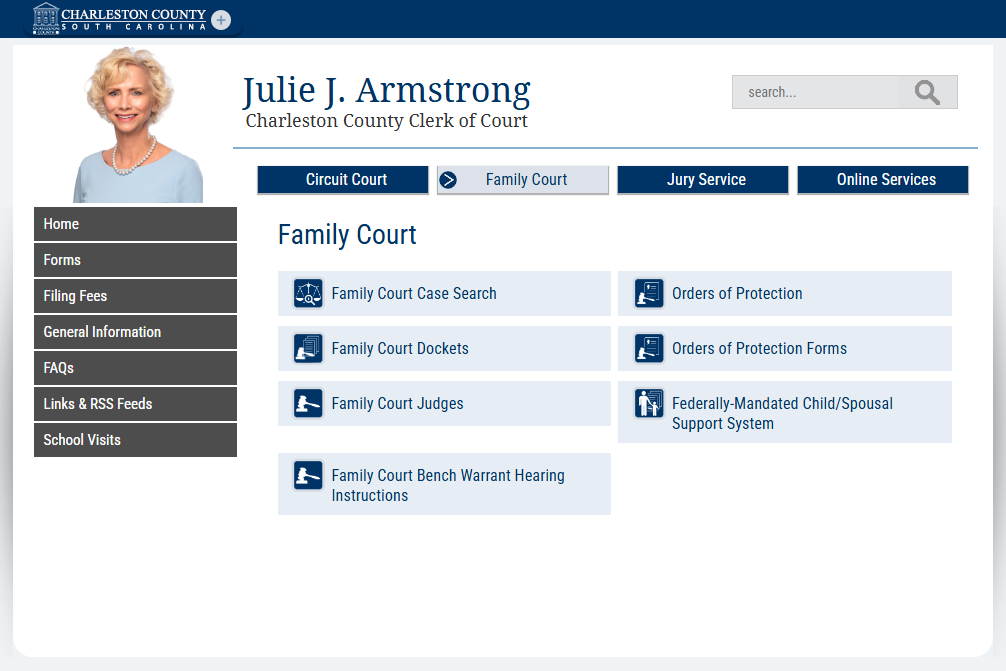
- Select Family Court from the court type menu.
- Enter the first and last name of the individual, or the case number if known.
- Optional: add a filing date range to narrow results.
- Click Search to view matching records.
Notes:
- Some records, like minor children’s information or sealed cases, are restricted.
- Public results typically include case type, parties involved, court dates, and case status.
Where to View Court Records and Cost
If online records are insufficient, users can request in-person access at the Clerk of Court or through third-party websites. The following options are commonly used:
| Method | Access Details | Cost |
|---|---|---|
| Online Portal | Full name or case number search for active or recent cases | Free |
| Clerk of Court Office | In-person access to physical or archived files | $0.50–$1.00 per page for copies |
| Third-party Public Records Websites | Search for case summaries and dockets | $5–$15 per record; prices vary by site |
| Certified Copies | Official court-issued documents for legal use | $5–$10 per page; additional fees may apply |
Types of Cases Heard
Charleston County Family Court deals with a variety of family-related legal matters. These include divorce, custody, support, protective orders, and adoption. Each case type has its own procedures, requirements, and considerations.
Divorce & Separation
Divorce and separation cases formally end a marriage and address related disputes. The court manages filings, hearings, and orders connected to marital disputes, including divorce petitions, separation agreements, and requests for property division. Divorces can be uncontested, where both parties agree on support and property division, or contested, requiring formal hearings and judicial decisions. Family Court also considers financial matters such as spousal support, ensuring fairness based on income, needs, and length of the marriage. Filing begins with submitting a petition to the court, following local rules and deadlines.
Custody & Visitation
Custody cases determine the living arrangements of children and who makes major decisions for them. Legal custody grants authority over education, healthcare, and welfare, while physical custody defines where the child lives. Courts set visitation schedules for noncustodial parents, covering weekends, holidays, and summer breaks, and arrangements can be modified if circumstances change. Mediation is often used to help parents reach agreements without prolonged litigation, keeping the focus on the child’s best interest.
Child & Spousal Support
Family Court oversees financial support to ensure children and former spouses receive the necessary assistance. Child support is calculated based on income, number of children, and custody arrangements, while spousal support may be awarded to maintain a reasonable standard of living after divorce. The court enforces payments through legal measures like wage garnishment and allows modifications if financial circumstances or the needs of the child change. Marriage & Divorce Records are often referenced in these matters to confirm legal marital status, document the date of separation or dissolution, and support requests related to support obligations. These records provide an official history that helps the court evaluate responsibilities and ensure decisions are based on accurate legal documentation.
Orders of Protection & Domestic Abuse Cases
Family Court handles domestic abuse matters, including issuing Orders of Protection to prevent threats, harassment, or harm. Anyone experiencing abuse, such as spouses, family members, or household members, can request an order. The court may restrict contact, require the abuser to leave a residence, and protect children. These cases are often expedited, with coordination between law enforcement and social services to ensure immediate safety.
Adoption & Termination of Parental Rights
Family Court manages adoption and termination of parental rights, which permanently alter parent-child relationships. Adoption transfers parental rights to adoptive parents and requires background checks and home studies, while termination legally ends a parent’s responsibilities, often before adoption or in cases of neglect. The court ensures all steps follow South Carolina law to safeguard the child’s welfare and long-term best interest.
How to File a Case in Charleston County Family Court
Filing a family court case in Charleston County begins with gathering the correct forms and understanding the filing process. Knowing the steps beforehand can help ensure the case moves smoothly through the system.
Required Forms & Where to Get Them
Before filing, it’s important to have the proper forms for the type of case. Charleston County Family Court handles cases such as divorce, child support, and custody disputes. Commonly used forms include:
- Divorce Complaint: Initiates a divorce case.
- Child Custody Petition: Requests custody arrangements for children.
- Child Support Worksheet & Petition: Used to establish or modify child support.
- Modification Petitions: For changes in custody or support orders.
- Mediation Request Form: Required in some disputes before court hearings.
Forms can be downloaded from the Charleston County Government Family Court website or picked up in person at the Clerk of Court’s office. Make sure to check for the most up-to-date versions to avoid delays.
Filing Fees & Costs
Filing a case in family court typically requires payment of fees, which vary by case type:
| Case Type | Filing Fee | Payment Methods | Notes |
|---|---|---|---|
| Divorce | $150–$200 | Cash, check, money order, debit/credit card | Fee may vary for simplified or contested divorces |
| Child Support | $50–$100 | Same as above | Some cases may qualify for fee waivers |
| Custody/Visitation | $50–$100 | Same as above | Check local fee schedule |
Payment is made to the Clerk of Court, either in person or by mail. Some courts also allow online payments, but confirm availability before filing.
Filing Process Walk‑Through
Charleston County Family Court offers several options to file a case:
- In-Person Filing
- Visit the Clerk of Court’s office.
- Submit completed forms and pay the filing fee.
- Staff may provide a receipt but cannot give legal advice.
- Mail Filing
- Mail completed forms with payment to the Clerk’s address.
- Include a self-addressed stamped envelope for confirmation.
- Electronic Filing (if available)
- Some cases can be filed through the court’s online portal.
- Ensure scanned documents meet submission requirements.
After submission, the court assigns a case number, which is necessary for tracking progress.
After Filing: What Happens Next
Once a case is filed, several steps follow:
- Service of Process: The other party must be officially notified, often through a sheriff or certified mail.
- Scheduling Hearings: The court will set dates for hearings, conferences, or mediation sessions.
- Case Management: Parties may be asked to provide financial statements, parenting plans, or other documents.
It’s possible to check the status of a case using Charleston County Family Court’s case search tools online. This allows parties to confirm hearing dates and any filings made by the other side.
Self-Representation vs Attorney Representation
Individuals can file and manage cases on their own (pro se) or hire an attorney. Benefits of attorney representation include guidance on legal strategy, drafting complex forms, and advocacy during hearings. Self-represented individuals must follow court rules carefully and ensure all forms are completed correctly.
Family Court Judges & Calendar
Family Court judges in Charleston County, SC, are local state judges who hear cases about divorce, child custody, support, adoption, and other family law matters. The list of assigned judges and their court calendars is public and updated regularly so that attorneys, parties, and the public can track who is on the bench and when hearings occur.
In Charleston, several judges serve on the Family Court bench, each with scheduled court terms throughout the year. The official roster and calendar show which Family Court judges are assigned to specific weeks or courtroom terms.
Local Family Court Judges
Below is a snapshot of judges regularly assigned to Family Court in Charleston County, SC, according to the South Carolina Judicial Branch listings:
Assigned Family Court Judges
- Michèle Patrão Forsythe: Chief Administrative Judge, Family Court
- Alice Richter: Family Court Judge
- Spiros Ferderigos: Family Court Judge
- Daniel Martin: Family Court Judge
- Blakely Cahoon: Family Court Judge
- Additional assignments may rotate during term weeks.
This roster may change as new terms begin or judges are reassigned. Local courthouses or the state site list the most current assignments, including emergency or special calendar weeks.
Viewing the Family Court Calendar
The public can view up‑to‑date Family Court rosters and calendars in two main ways:
Official Charleston County Roster Pages
Charleston County Government publishes weekly schedules showing which family judge presides each week. These rosters include current and upcoming assignments.
South Carolina Judicial Branch Calendar Search
The Judicial Branch offers a searchable calendar where users can:
- Look up hearings by judge name
- Search by county or circuit number
- See dates and times for scheduled sessions
The calendar shows upcoming Family Court dates, reports, and courtroom schedules.
Location, Hours & Contact
Charleston County Family Court is located at the Charleston Judicial Center, Suite 143, 100 Broad Street, Charleston, SC. Visitors can reach the court during regular office hours or contact staff directly for specific family court inquiries.
Charleston County Family Court handles a range of cases, and having accurate location and contact information helps visitors plan their visits efficiently. The court is situated within the Charleston Judicial Center, making it easily accessible from downtown Charleston. For parking, the building offers designated visitor spaces nearby, and public parking garages are within walking distance. Security at the entrance is managed by the Charleston County Sheriff’s Office, so all visitors must pass through routine screening.
Office Hours:
- Monday – Friday: 8:30 AM – 5:00 PM
- Closed on county holidays
Contact Information:
- Clerk of Court Main Line: (843) 958-5000
- Family Court Direct Line: (843) 958-5005
- Charleston County Government: www.charlestoncounty.gov
Visitors are encouraged to have all necessary paperwork ready and to arrive early to allow time for security screening. The court maintains a calm and organized environment to assist with filings, hearings, and other family-related proceedings.
Frequently Asked Questions About Family Court
Charleston County Family Court often receives questions from families about custody, divorce, and other family law matters. The following FAQs provide clear answers and helpful information to guide residents through common procedures and legal processes.
What types of cases does Charleston County Family Court handle?
Charleston County Family Court handles a variety of family law matters, including custody cases, divorce filings, child support disputes, and protective orders. The court also oversees adoption proceedings, paternity claims, and visitation arrangements, providing a legal framework to resolve family disputes fairly. Families may also have access to mediation services to help reach agreements without lengthy hearings, and judges consider the best interests of children and family members in all decisions.
How do I file for custody?
To file for custody in Charleston County, a parent or guardian must submit a Complaint for Custody to the Family Court clerk’s office. The court evaluates details such as the child’s living arrangements, health, schooling, and parent involvement. Petitioners should provide supporting documentation, including school records, medical reports, and communication logs, which help the court make informed decisions. Mediation may also be offered to encourage agreement between parents before a formal hearing.
What is the difference between an order of protection and visitation rights?
An order of protection is designed to protect individuals from domestic violence or harassment, while visitation rights determine how and when a parent spends time with their child. The Family Court may adjust custody or visitation schedules if safety concerns exist, and judges weigh the child’s well-being and parental fitness in their rulings. Orders of protection can include restrictions on contact, stay-away requirements, and temporary custody modifications when necessary.
Can I represent myself?
Individuals may represent themselves in Charleston County Family Court, but legal guidance is often recommended for contested cases. Representing oneself, known as pro se representation, requires completing all forms correctly, meeting court deadlines, and presenting evidence effectively. This approach is more suitable for uncontested matters like simple divorces or agreed-upon custody arrangements, whereas complex cases involving child support disputes, protective orders, or contested custody usually benefit from an attorney’s experience in family law matters.
What documents do I need for a divorce filing?
Filing for divorce in Charleston County requires submitting a Complaint for Divorce along with supporting documentation such as financial disclosures, property statements, and child custody or support information if applicable. Petitioners must also provide a marriage certificate and any prior court orders relevant to the case. Completing these documents accurately ensures the case proceeds smoothly, and additional paperwork may be requested by the court depending on the circumstances, including residency verification or evidence of domestic incidents.